Showing posts with label Ornate Burrowing Frog. Show all posts

Saturday, May 10, 2014

The Last of the Summer Frogs

The wet season was very short lived this year. Within about two weeks of the only significant rain for the summer, most of the summer frogs had stopped calling. This was due to little follow up rain and the early onset of the colder weather. The numbers of several species was down significantly compared to the last few years. I would expect that the severe drought was the main contributing factor. On the other hand some other species have increased in numbers. At least the wet season did arrive and give an opportunity for the frogs to breed, even though it was for a shortened period. Hopefully enough have breed to boost the numbers of frogs back to similar numbers. During the few weeks after the rain many species were out breeding in good numbers so time will tell if the breeding season was long enough.

In the last few days before most of the summer frogs had stopped calling I went for a walk around the property. Most of the same species were sighted as in my last post except for the Northern Banjo Frogs, Dainty Tree Frogs and the Keferstein's Tree Frogs. There was a noticeable decline in numbers of  every other species that was sighted compared to the few weeks prior. I only took a few photos as it was getting late and I was determined to get a decent photo of the Tyler's Tree Frog for this season, which took quite a while.

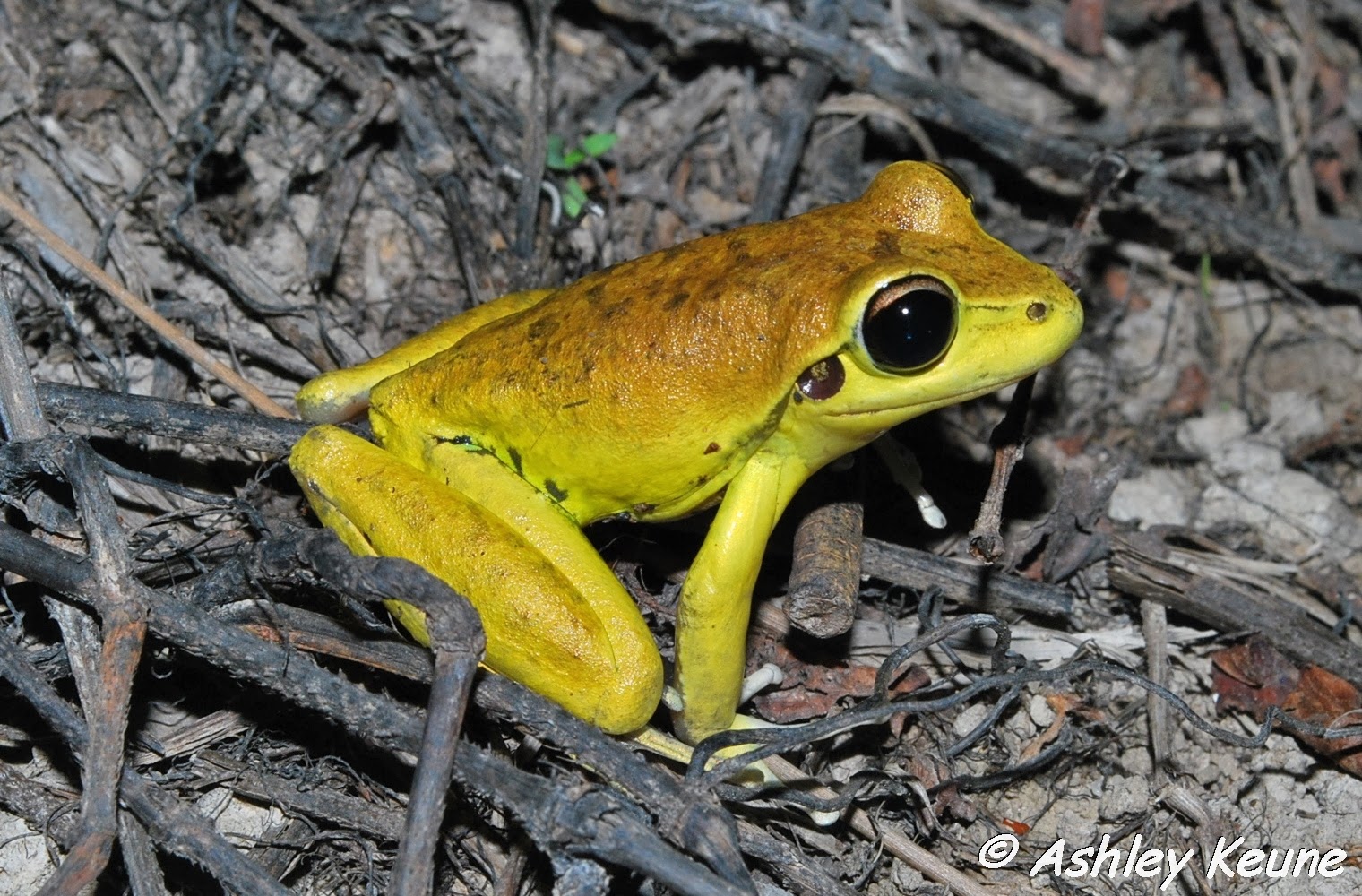
A few Ornate Burrowing Frogs were spotted. This one was out in the open so it was easy to get a good photograph. As mentioned in other posts this frog can be extremely variable in colour/pattern and even skin texture. I have several, very different colours/patterns of these frogs on the property. This colour variation has been seen on the property before but is less common than the other colours/patterns found here. The shape of these frogs is quite distinct, along with the protruding eyes, but to be certain for identification, all specimens have a distinct plain circular patch between their eyes, on their back.


Ornate Burrowing Frog side view


Ornate Burrowing Frog top view, showing the circular patch between the eyes


I had to wade across the creek again to get to the Tyler's Tree Frogs. I could hear a couple calling from the house which is why I actually went out frogging briefly tonight. Luckily one of the two was sitting reasonably low on a branch, overhanging the water. It took quite a while to get a photo as I couldn't look through the eyepiece of the camera due to the height of the branch. I am concerned about the limited number of Tyler's Tree Frogs sighted and heard this year. They have only ever been heard in a small stretch of one creek on the property and only three or so were heard at one time this season. They were always in limited numbers on the property. About 25 - 30 individuals is the most I had seen and heard at any time, and most nights when they were active they usually numbered between six and twelve.


The left side of this creek is the only place the Tyler's Tree Frogs are found


Back view of one of the Tyler's Tree Frogs


The other specimen of the Tyler's Tree Frog


The same Tyler's Tree Frog as above


Tyler's Tree Frog calling


The Green Tree Snake below was in the same tree as the two Tyler's Tree Frogs. It would be one of the longest specimens that I have seen of this species. It would have been close to two and a quarter metres and had 6 distinct lumps in its belly. Most of these I presume would have been frogs. After the snake was in the tree I only heard the one Tyler's Tree Frog call out for the remainder of the night. Hopefully the Green Tree Snake didn't eat one.


Green Tree Snake


This is a recording of the advertising call of the Tyler's Tree Frog. The first frog heard in the recording is actually a Peron's Tree Frog and it continues to call throughout the recording in the background. The loud "laughing" frog in the foreground is the Tyler's Tree Frog. Eastern Sign-bearing Froglets can also be heard continually throughout the recording. They have the high pitched "eeek" sound. The occasional Eastern Dwarf Tree Frog can also be heard.


Several Peron's Tree Frogs were seen and many more heard but this was the only one that I could access easily to photograph. They look very similar to the Tyler's Tree Frogs and Roth's Tree Frogs. I get all three of these species on my property and all three are known as the laughing tree frogs. The Roth's can be easily distinguished from the other two species by the colouring of the pupil. To identify Peron's Tree Frogs and Tyler's Tree Frogs is more difficult as they are more similar in appearance. I find the Person's Tree Frogs here have a rougher textured skin and darker markings, but this is not always the case. The blotching and patterning can change between the species so this isn't a reliable way to identify them. The best way is to observe them calling as their call is the best way to identify them, which is what I do. The Peron's Tree Frogs also have tiny green specks scattered over the dorsal surface and legs. Sometimes these specks can be hard to see though.


One of the several Peron's Tree Frogs that were sighted


The same Peron's Tree Frog from above


Peron's Tree Frog


Tonight the big Green Tree Frog on the veranda didn't want to come out of his day time hiding hole.


The big Green Tree Frog


Tonight was the first time that I had sighted the Broad-palmed Rocket Frog this season. The quantity of this species on the property is always much less than the Striped Rocket Frogs but they can usually be seen most nights after decent summer rain. This was not the case this year! The Striped Rocket Frogs would have numbered many thousands on the property. Several hundred could be seen easily most nights after good rain in a small area whereas the Broad-palmed Rocket Frogs I would estimate in the low hundreds and maybe less. The most I have ever seen in one night would have been about 30 individuals.


Broad-palmed Rocket Frog


The same Broad-palmed Rocket Frog from above


The Broad-palmed Rocket Frog from above


The biggest decline in frog numbers I noticed this year was with the Rocket Frogs. Each night less than 150 Striped Rocket Frogs were found and significantly less where heard calling throughout the property compared to the last four years. For the entire year I only sighted two Broad-palmed Rocket Frogs on the property!! Hopefully this decline in numbers was just due to the drought and the numbers pick up again in the coming years if we get better rain spread more consistently throughout the summer. Nothing else has changed in the last two years like slashed areas of the property and the times when the property is slashed. I will get a better indication of factors that effect the frog populations, the longer I observe the numbers and species of frogs on the property, the weather, farming practices etc on the property. I have something very unique here and I do everything possible to help increase the populations of the native animals.

This is a recording of the advertising call of the Broad-palmed Rocket Frog.  A Cane Toad can be heard at the beginning of the recording in the background.

The Cane Toad was located and disposed of humanely. Very few are heard calling around the property now due to me gradually removing them over the last 4 years.


More pics and updates when more frogs are photographed and recorded.

Tuesday, April 1, 2014

Frogging Around My Property: 19 Species Recorded in a Few Hours

Last Saturday Jono, the creator of the frog blog, Frogging Around (http://froggingaround.com/blog) and one of his mates came to my place for a visit. He has been here before but not during the peak of the wet. After all the rain he thought it would be a great opportunity to see what my property really had to offer in terms of frog species. To be honest I think he was even a little sceptical about the number of species that I claimed to have on my property. I was hoping to at least see and hear the same number of species as I did a few nights prior. They arrived here around 6:30. It hadn't rained for nearly 2 days so I was hoping that all the frogs would be as active. There was still heaps of water around so I was confident that we would see numerous species.

We started off on the veranda where the Roth's Tree Frogs have been residing. Not as many were present tonight but we still got to see them.


One of the pale coloured Roth's Tree Frogs


One of the darker coloured Roth's Tree Frogs


There were also a few Green Tree Frogs on each veranda. I didn't bother getting any pictures of them tonight. As we made our way down to the main dams not far from the house Eastern Sign-bearing Froglets could be heard as well as many Striped Rocket Frogs, Striped Marsh Frogs and Eastern Dwarf Tree Frogs. Several Red Tree Frogs were also heard in this area.


Striped Rocket Frog


One of the many Eastern Dwarf Tree Frogs


Striped Marsh Frog


As we moved around to another dam I was hoping that the rocket frogs that I could hear were the Broad-palmed Rocket Frogs but none were sighted again tonight. We spotted one lone male Wilcox's Frog in the area where they are most common. As I went to obtain a photo he jumped into the long grass. This male was quite dark compared to most photos I have of them as their breeding season is nearly finished. More Wilcox's Frogs may have been present but we didn't really spend much time looking as we had both seen heaps of them before. We were looking for a few species in particular!

As we came around to the next major waterway we heard several Peron's Tree Frogs, a couple of Tyler's Tree Frogs, some Red Tree Frogs and heaps of Striped Marsh Frogs. One Peron's Tree Frog was reasonably close to the bank on a stick in the water. Due to the angle of the bank I wasn't able to get a good shot of him. The Peron's Tree Frog, also known as the Emerald Spotted Tree Frog is another one of my favourite frogs on the property, so I couldn't pass up a photo opportunity!


Peron's Tree Frog


The same Peron's Tree Frog from above


Below is a picture of one of the many Red Tree Frogs that were heard. They were even more vocal tonight than the other night. It's great to see that they are breeding in the natural habitats this year. We were hoping that this was a Bleating Tree Frog or as I usually call them Keferstein's Tree Frog. They look so similar on my property and in general they can look very similar. The only way to be absolutely certain is to play their call. Even their call is very similar. The Keferstein's Tree Frogs call is a higher pitched and slightly quicker. Visually the Keferstein's Tree Frog usually has a darker marking on its back.


Red Tree Frog


This is a recording of the advertising calls of several frogs. The Tyler's Tree Frogs is the laughing sound in the background that occurs regularly throughout the recording. Some Red Tree Frogs call out in the foreground at the start of the recording and then again in small bursts at the end. The Eastern Dwarf Tree Frogs and Striped Marsh Frogs call out continually throughout the recording. The Striped Marsh Frogs is the clicking type sound throughout the recording.


This Eastern Small-eyed Snake was a bit of a surprise. Jono's friend nearly stepped on this snake but stepped straight over the top of it. Luckily it wasn't me that nearly stood on it as I was only wearing thongs! Luckily it didn't bite any of us as it was quite aggressive!


An Eastern Small-eyed Snake


Several Great Barred Frogs were seen in their usual place. Many others were heard as well. I was very surprised as most of the ones that we sighted were quite small. I have never seen them that small since I have lived here. This is good though, as it means that they have been breeding. They were most likely juveniles from last years breeding season. They were probably less than five centimetres long.


Great Barred Frog


We were lucky enough to sight a pair in amplexus just near the bank. I was lucky as I was the only one that obtained a photo. In this area we heard the first Tusked Frog for the night. This male was guarding a foam nest in a burrow in the bank of the creek. Due to the position of the burrow I wasn't able to get a photo. They can easily number hundreds but usually not until the water level in the creeks start to drop significantly.


A pair of Great Barred Frogs in amplexus


This is a recording of the advertising call of a few Great Barred Frogs. Several Striped Marsh Frogs can be heard in the background throughout the entire recording.


As we made our way towards the front paddocks where the flood waters were sitting, we saw many Striped Marsh Frogs of varying sizes. A few Spotted Marsh Frogs were also sighted. Most were calling from beneath the ground and from their burrows.

This is a recording of several Spotted Marsh Frogs performing their advertising call from beneath the ground and in their burrows.


I was surprised when Jono spotted this Large Toadlet. These are also known as Major Toadlets. Usually they are very difficult to find as they call from beneath the ground or under deep leaf litter and I have found they are more active once the majority of the floodwater has resided. They can be extremely variable in colour from this bright red back with bluish sides to a dark brown or even grey back to grey or nearly white sides. The orange or yellow mark on the upper arms is one of the distinguishing features along with the darker makings along the longitudinal ridges along its back.


The only Large Toadlet sighted for the night


View of the Large Toadlet from above (notice the dark longitudinal ridges)


We heard a few Ornate Burrowing Frogs calling from the longer grass in the flooded paddock. This specimen was out in the open. This was the first time I have seen them in the water in the calling position. This frog also varies greatly in colour from one area to another and even within a small area. I have several colour variations on my property alone.


Ornate Burrowing Frog


Within the same area we also heard numerous Northern Banjo Frogs. I have only ever seen one individual on the property since I have lived here so it was nice to see that the population of these frogs has increased significantly over the last two years. I was surprised to see that some of them were calling from quite high in the reeds, about 20 to 30 centimetres out of the water. At any other location around Australia that I have seen and heard them calling, they were actually sitting in the water. These frogs are also known as Scarlet-sided Pobblebonks.


Northern Banjo Frog


This is a recording taken in the front paddock. You can here the advertising calls of several frogs. The main calls are the Eastern Sign-bearing Froglet and the Striped Rocket Frogs which can be heard continually for the entire recording. The Northern Banjo Frog can be heard throughout the recording also. It is the deeper call that sounds like a "bonk" sound, that is a single note.


We heard a few Common Froglets in the front paddock but they were few in number and they were not calling continually like they normally do. As mentioned in the last post they can change significantly in numbers with the seasons. They seem to like the cooler weather generally. I heard one calling from beneath a tree and I found two specimens of frogs under this tree. I didn't see either of them calling. I am quite sure that the frog below is a Common Froglet. They can be difficult to identify due to the great variation in colour, patterning and texture. I have seen many Common Froglets that I have identified on the property as I have located them calling. The advertising call is the most reliable way to identify them as they perform a repeated clicking sound. This specimen below is extremely similar to all the other Common Froglets that I have identified here over the last few years.


Common Froglet


This next photo is the other frog that was found beneath the tree with the presumed Common Froglet above. This appears to be an Eastern Sign-bearing Froglet. They could be heard calling in very large numbers across the entire paddock. We were having real difficulty in locating them though. We did not see this frog calling either but one could be heard calling from beneath the tree as well. This specimen looks slightly different from other Eastern Sign-bearing Froglets that I have positively identified on the property. This species of frog can be very hard to distinguish from several species due to the potential differences in colour, patterning and texture also. I heard no other frogs calling from within the area and no other frogs were sighted so I assume this is a Eastern Sign-bearing Froglet, as it has many characteristics similar to other specimens.


Eastern Sign-bearing Froglet, side view


Eastern Sign-bearing Froglet from above

Just before Jono and his friend left we decided to go back to where I heard the Verreaux's Tree Frog several months back and where I heard it a few days before. We heard it do a part call but it didn't continue to call. It was in an area of long grass so it wasn't worth digging through hoping to find it as it stopped calling. We didn't want to go in without having a more precise location so we didn't stand on it. I played the Keferstein's Tree Frog call to ensure that the frogs we could hear were definitely Red Tree Frogs. I find this the best way to ensure which call I am listening to by comparing the advertising call with one I can hear with a recording. The frogs we could hear were Red Tree Frogs. Much to our surprise, the main frog that Jono was hoping to see called out. It was the
Keferstein's Tree Frog. It responded to the Keferstein's Tree Frog call that I played!!

The Keferstein's Tree Frogs look very similar to the Desert Tree Frog but the Keferstein's Tree Frog has the darker markings on its back, even if they are extremely faint. This individual's markings were quite obvious compared to some others I have seen on the property.


Keferstein's Tree Frog


The markings on the back of this Keferstein's Tree Frog were obvious


Another specimen of the numerous Striped Marsh Frogs that were sighted all around the property. Definitely the most common frog of the night. They would number in the thousands across the entire 45 acre property.

Striped Marsh Frog


After Jono left I decided I would walk across to the little island in the middle of the creeks where the Tyler's Tree Frogs and the Peron's Tree Frogs call from and breed. I was wanting to get a photo of the Tyler's Tree Frog for the season. I found them but they were high up in the tree. I only had my close up lens on my camera so this is the best photo I could manage. I will have to try and get a better photo of them in the coming weeks.


Tyler's Tree Frog four metres up the tree


While I was walking back towards the shallow part of the creek to cross back, this Eastern Sign-bearing Froglet was calling from a piece of bark that was floating on the water's edge. This specimen is what the typical Eastern Sign-bearing Froglets look like on my property. I can say definitively that this is an Eastern Sign-bearing Froglet as I saw it calling.


Eastern Sign-bearing Froglet from above


Side view of the same Eastern Sign-bearing Froglet


This is the most species that I have found in a given night on the property, or anywhere for that matter, anywhere I have travelled around Australia. All of these species have been recorded here before but I have not seen them all on one night, or even within a week. I am extremely lucky to be able to see and/or hear 19 species in a few hours, within my own backyard. This is why I am pleased that I was able to purchase the property a few months ago to help protect it and continue to improve it over the coming years for a variety of wildlife.


More pics and updates when more frogs are photographed and recorded.

Tuesday, November 26, 2013

The First Photograph of Another Species at my Property

Last night I went out to take some photos of the frogs on my Coles Creek property as they were extremely active last night. About 3 weeks ago the rocket frogs started calling again and last night they were in large numbers for the conditions. In a 150 m2  area close to the edge of the creek and dam there would have been approximately 120 Striped Rocket Frogs and on the opposite bank were about 20 Broad-palmed Rocket Frogs. Once the property starts to flood the Striped Rocket Frogs will number thousands  over the entire 45 acres and the Broad-palmed Rocket Frogs will reach many hundreds. The number last night is high for how dry the property is at present. Over the last several weeks as well I have seen massive numbers of the Wilcox's Frogs as well. Last night I spotted more than 60 without looking too hard. All, except for about 6 of the ones sighted were males.

While I was out taking photos I spotted a frog that I have seen many of, in my travels and I have photographed on several occasions. I have seen them on the property two times before but hadn't photographed them here. Last night I was lucky enough to see three of them and was able to photograph two of them!! They were the Ornate Burrowing Frogs. This keeps the number of species I have seen on my property at 26 species. I have now photographed 19 species at my property this year for this blog!

Two of the female Wilcox's Frogs that I saw were in amplexus.


A male and female Wilcox's Frog in amplexus


The same pair of frogs as above


The male is much smaller than the female and mainly yellow when breeding


The female is much larger and usually tan to grey in colour


The male can hold on even after the female jumps (which can be over 2 metres)


This is one of the many Striped Rocket Frogs that were seen. Getting a photo of them proved more difficult. As soon as I squatted near them, they jumped off or they were too difficult to photograph in amongst the reeds and plants.


Striped Rocket Frog


The same Striped Rocket Frog


This is a recording of the advertising call of the Striped Rocket Frog.


I was so surprised to see one of these Ornate Burrowing Frogs last night as they are not a common visitor here... or they are not seen regularly anyway. This species of frog can be highly variable in colour and skin texture even within the same location. The first few that I saw were nearly identical, except for their size.


Ornate Burrowing Frog


Ornate Burrowing Frog from above


Right side of the Ornate Burrowing Frog

Ornate Burrowing Frog from front on

Left side of the Ornate Burrowing Frog


The Ornate Burrowing Frog from directly above


The next few pictures are photographs of the second specimen of the Ornate Burrowing Frog that I saw a few minutes later.


The left side of the second Ornate Burrowing Frog

The right side of the second Ornate Burrowing Frog


The second Ornate Burrowing Frog again


I was surprised by how photogenic some of the Broad-palmed Rocket Frogs were, compared to the Striped Rocket Frogs. I didn't see any of them mixed in with the opposite species. They were both in their own groups on opposite banks. To hear them calling without seeing them I cannot tell the difference in their advertising call.


Broad-palmed Rocket Frog


Broad-palmed Rocket Frog close up


Right side of the Broad-palmed Rocket Frog


The same Broad-palmed Rocket Frog


This is a recording of the advertising call of the Broad-palmed Rocket Frog. Unfortunately you can hear a toad in the background. I'm sure that I won't hear it call out again though.


This is becoming a regular sight, with the male Wilcox's Frogs in amplexus with another species. At least this time it was a frog and not a toad. I wonder if this has to do with such a difference in numbers of males compared to females of this species or they just don't care!!


Wilcox's Frog in amplexus with a Striped Rocket Frog


A Wilcox's Frog in amplexus with a Striped Rocket Frog again


A few more photographs that I was able to get of another specimen of the Striped Rocket Frogs.


Striped Rocket Frog


This was a big female Striped Rocket Frog from above


Left side of the female Striped Rocket Frog


The next three photographs are all of the same frog. When I was taking the photos I thought it was another Ornate Burrowing Frog as I had already seen three prior to seeing this frog. I knew it looked different in colour and slightly larger as well, as soon as I saw it. I also know that they can be greatly different in colour in one small area too. I didn't realise until I downloaded the photos though that the pupils are very different in this specimen. In all the photos of Ornate Burrowing Frogs that I have taken and the ones I remember seeing they all have a pupil pattern the same as the first Ornate Burrowing Frog in this blog. As far as I knew this was one of the distinguishing features of this species. Too be honest I'm not absolutely certain what this frog is. I assume that it is an Ornate Burrowing Frog but I will have to check with the experts.

I have checked with Aaron, an expert in frogs, and he has confirmed that these are indeed Ornate Burrowing Frogs. The difference in the pupil is due to the pupil being dilated, which must be less common when photographing frogs. He has given another or better identification for Ornate Burrowing Frogs as well. He said that all specimens that he has come across have a distinct plain circular patch behind the eyes. This should be used as a key feature along with eyes and body shape to help identify this species.

You can check out Aaron's amazing frog photos, and other animals also by clicking on the link below.

http://www.flickr.com/photos/23031163@N03/


A different colour variation of an Ornate Burrowing Frog


The same Ornate Burrowing Frog from above


The Ornate Burrowing Frog from above with the distinct circular patch


The Wilcox's Frog were very obvious in their breeding colours. It is great to see that their numbers have continued to increase on the property. They have also started to spread into other areas on the property.


Male Wilcox's Frog


The same Wilcox's Frog


Another male Wilcox's Frog


The same Wilcox's Frog from above


More pics and updates when more frogs are photographed and recorded.